|
 WHAT
IS SOY? WHAT
IS SOY?
In
the fifteenth century B.C., an Asian legume known as the soybean
was cultivated from its wild state to become a boon to humankind.
No one then understood the properties of the bean, but the
Chinese farmers who grew it observed that this remarkable
food helped keep their families healthy. The plants provided
good forage for livestock and maintained the viablility of
the soil as well. Today, this miracle crop thrives on thousands
of farms throughout America’s heartland.
In fact,
the United States grew 2.5 billion bushels of beans in 1995
alone, accounting for 50% of the world�s production. During
the last hundred years, some of the complexities of the bean�s
composition have been revealed. We now know that each soybean
�pea� contains proteins, carbohydrates, fiber, fat, vitamins
and minerals. These components make soybeans a nutritious
food for humans. They also allow soybeans to be used for a
host of other products in agriculture and industry.
Source:
United Soybean Board
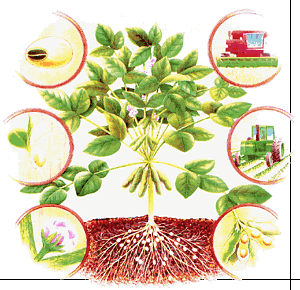
Growing
Soybeans
1. Soybeans
are a summer annual usually planted in May or early June.
It takes about 75 - 80 days for the beans to fully mature.
Mature plants may reach a height of 3 feet or more.
2. Soybean
sprouts need plenty of rain alternating with periods of sun.
3. Small
pink, purple or white flowers grow in the axil where the leaf
joins the stem.
4. The
“seeds” of the plant are the soybeans. These seeds
are borne in hairy pods that grow in clusters of three to
five. Each pod contains two or three seeds, resembling peas.
5. Soybeans
are easy to cultivate. The plant even “pays rent”
by returning soil-building nitrogen to the fields.
6. Soybeans
are ready to harvest in September or October. When the seeds
are mature, the upright vine and foliage begin to shrivel
and the leaves fall away. Harvest must be completed before
the pods shatter and burst open. All harvesting is done by
machine.
Source: United Soybean Board
Soybean
Composition
Like the protein found in animal products, the protein in
soybeans is “complete,” meaning all of the eight
amino (protein) acids needed for human health are present.
The soybean is the only vegetable food that is a complete
protein.
Soybeans
are also an excellent source of dietary fiber.
Among
legumes (beans, peas and lentils) soybeans have a relatively
high oil content.
Lecithin
is extracted from soybean oil. A natural emulsifier and lubricant,
lecithin is used for everything from pharmaceuticals to protective
coatings. For example, lecithin is used to keep the chocolate
and cocoa butter in a candy bar from separating.
Source: United Soybean Board
Back
To Soy & Your Health Main Page
|